Entangled Systems.

Photo by Ayça Tuğran
-
Speculative design research
(M.A. Thesis Research and project) -
Berlin, Germany
University of Europe for Applied Sciences -
Prof. Emily Smith
Riccardo Torresi -
e-waste, IT specific (wires, keyboards, headphone, hard disks, earphones, cables etc), mycelium composite (from grown.bio)
-
Berlin New Media Week (Sept 2025) & MaHalla Open for Berlin Art Week (Sept 2025) as a part of the curated exhibition ‘Intelligent Kin’ at MaHalla, Berlin.
DIGITAL MEDIA OBSOLESCENCE // E-WASTE
FORESIGHT RESEARCH // SPECULATIVE DESIGN // GROWING DESIGN // MATERIAL SCIENCES // MEDIA ECOLOGY & MATERIALITY
MATERIAL DRIVEN DESIGN // BIOMATERIALS // SCULPTURES
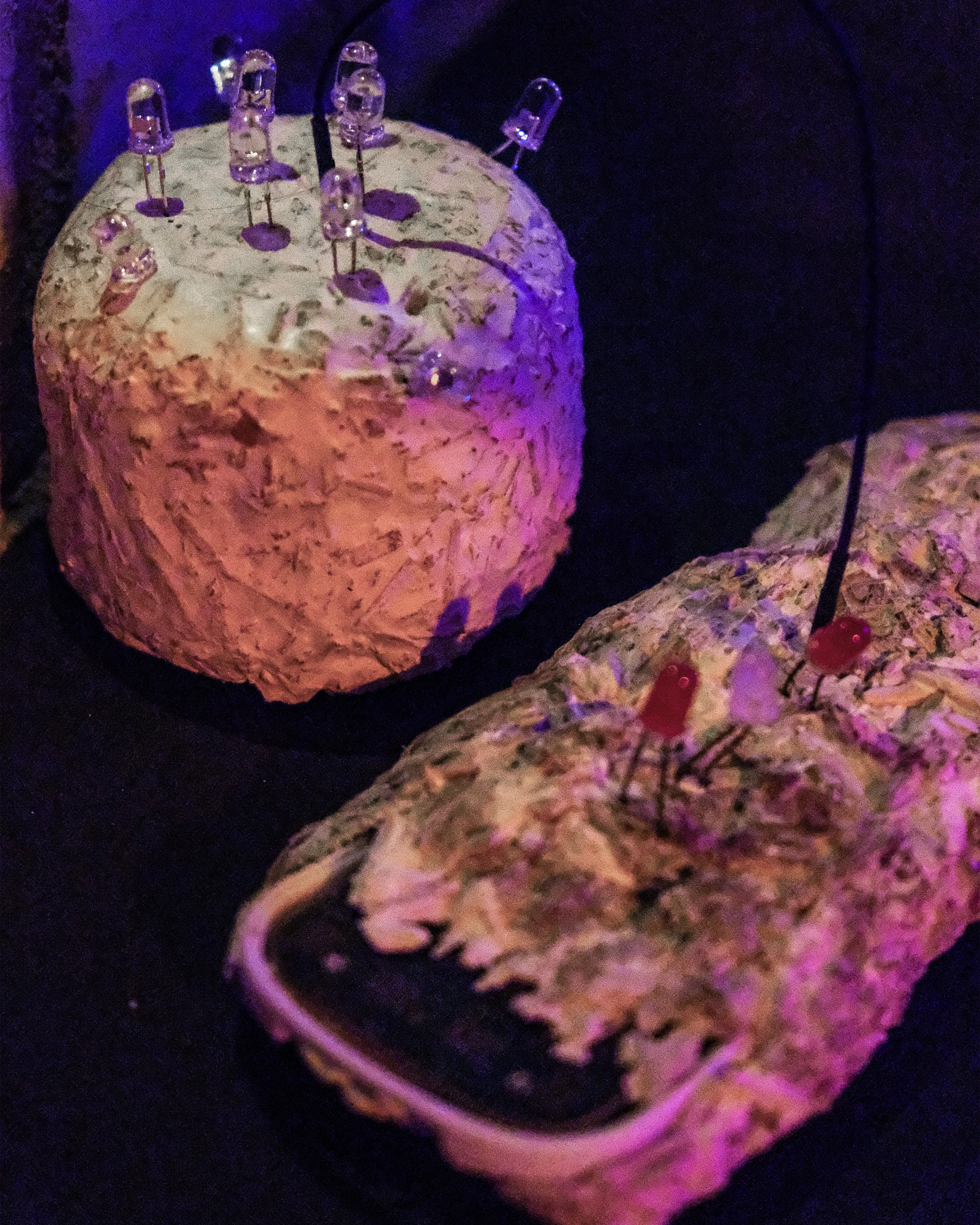
Landfill 0800, 2125
-
Entangled Systems is a speculative material inquiry beyond the obsolescence of discarded digital media—an experiment in the interplay between digital media waste and fungal networks.
In this museum of obsolescence, imagined, reside renewed living systems, found growing in electronic waste landfills.
Set 100 years in the future, it envisions a world where obsolete technologies, buried in the soil, have evolved without human interference and become entangled with non-human ecologies. Living sculptures of mycelium and obsolete media explore how decaying digital forms meet fungi—and the hybrid bio-digital materialities that may emerge. It reframes obsolete digital media as living repositories of memory, both material and digital.
And finally, prompts us to rethink digital media not as ephemeral things, but as living systems, hopefully encouraging more responsible and conscious design practices in the future.
““When you go to the toilet, shit disappears. You flush it.
Of course, rationally, you know it’s there, in canalization and so on, but at a certain level of your most elementary experience, it disappears from your world.””
The discarding of waste in our world, and its disappearance, exists merely in our minds and not as a physical reality. It is nothing more than an illusion that colours our daily perception. Yet it serves as a reminder of the larger impacts of the daily subconscious habits of the human mind. This waste, out of sight and out of mind, disappears only to reappear again in our landfills. The artistic research is inspired deeply by the concepts of Craftoscene (originally crafted by SUPERFLUX) exploring questions of what might the future look like if waste becomes a resource?
Within existing ecologies of waste, Entangled Systems speculates about the materiality, obsolescence, and future of electronic waste.
How will digital media waste evolve beyond it’s
designed obsolescence?
What is found 100 years later?
REDUCTIO AD ABSURDUM
>>>
REDUCTIO AD ABSURDUM >>>
“A form of logical argument in which ‘a claim is assumed for the sake of argument, and it derives an absurd outcome by taking it to the extreme, concluding the original claim must have been wrong because it led to such an absurd result’.”
(ASSUMED) CLAIM
All digital media eventually die.
Their death is inevitable.
THE ABSURDITY
The obsolete media continue to live on, take new material forms, and interact with non-human entities - fungi.
WONDERING
?
WONDERING ?
Without human intervention, how will obsolete data on devices be encrypted, reinterpreted or consumed by fungal intelligence?
What does the future material aesthetic of digital media look like?
In a world without binary code, what languages might emerge from the entanglement of fungi and obsolete media?
If not humans, then who will these
living, growing bio-digital hybrids
serve?
Who will be their new user?
Maybe this new world defined by perpetual re-creation, rather than perpetual innovation.
Is this the new post-industrial digital avant-garde, where waste becomes a resource?
MUSEUM OF OBSOLESCENCE
Uncovering archived digital media fossils,
living, breathing in their new forms.
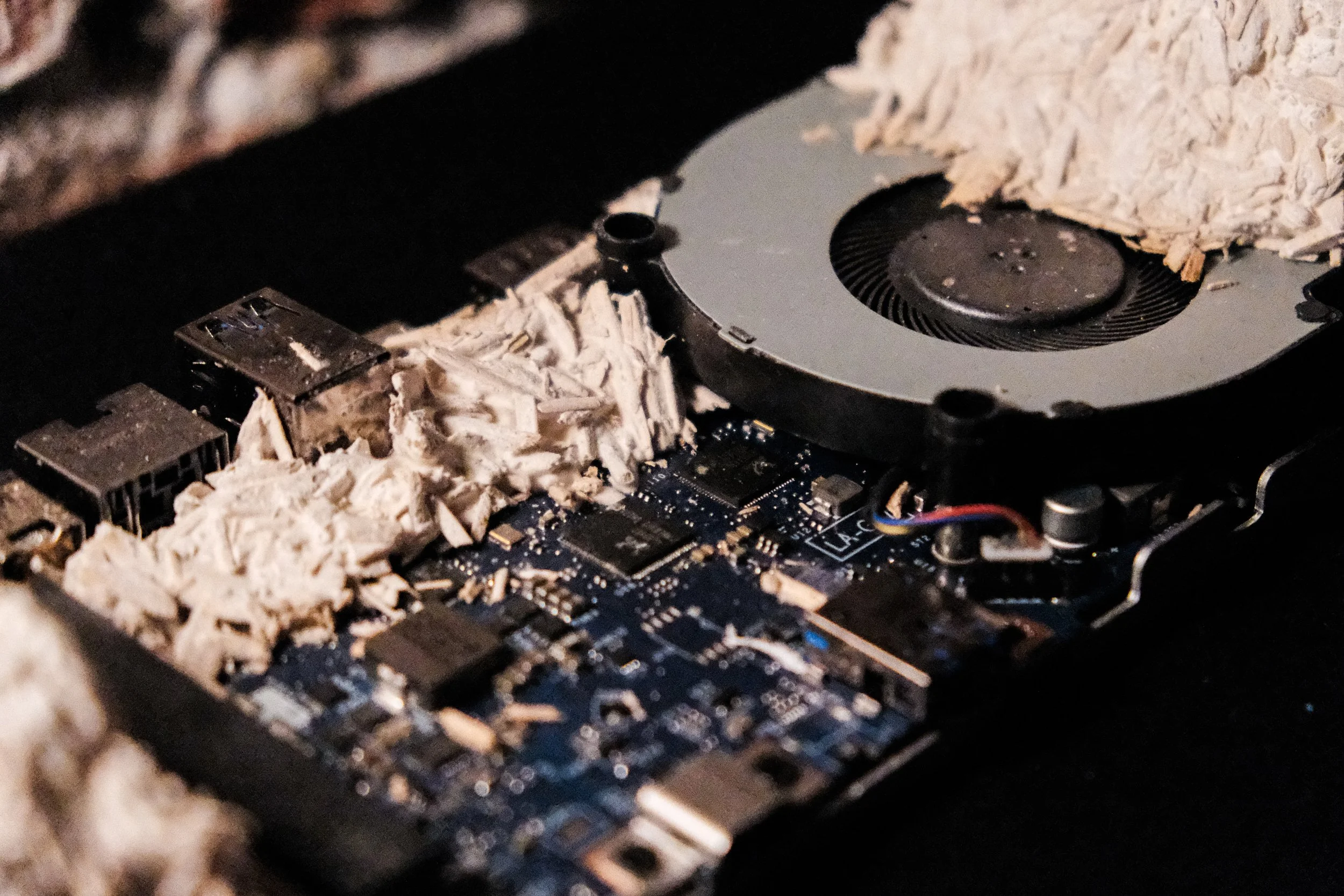
1.
The year is 2125. As far as the eye can see, exhausted soil lies beneath, while above ground are the remnants of the digital age.
Endless terrains of a
post-industrial world.
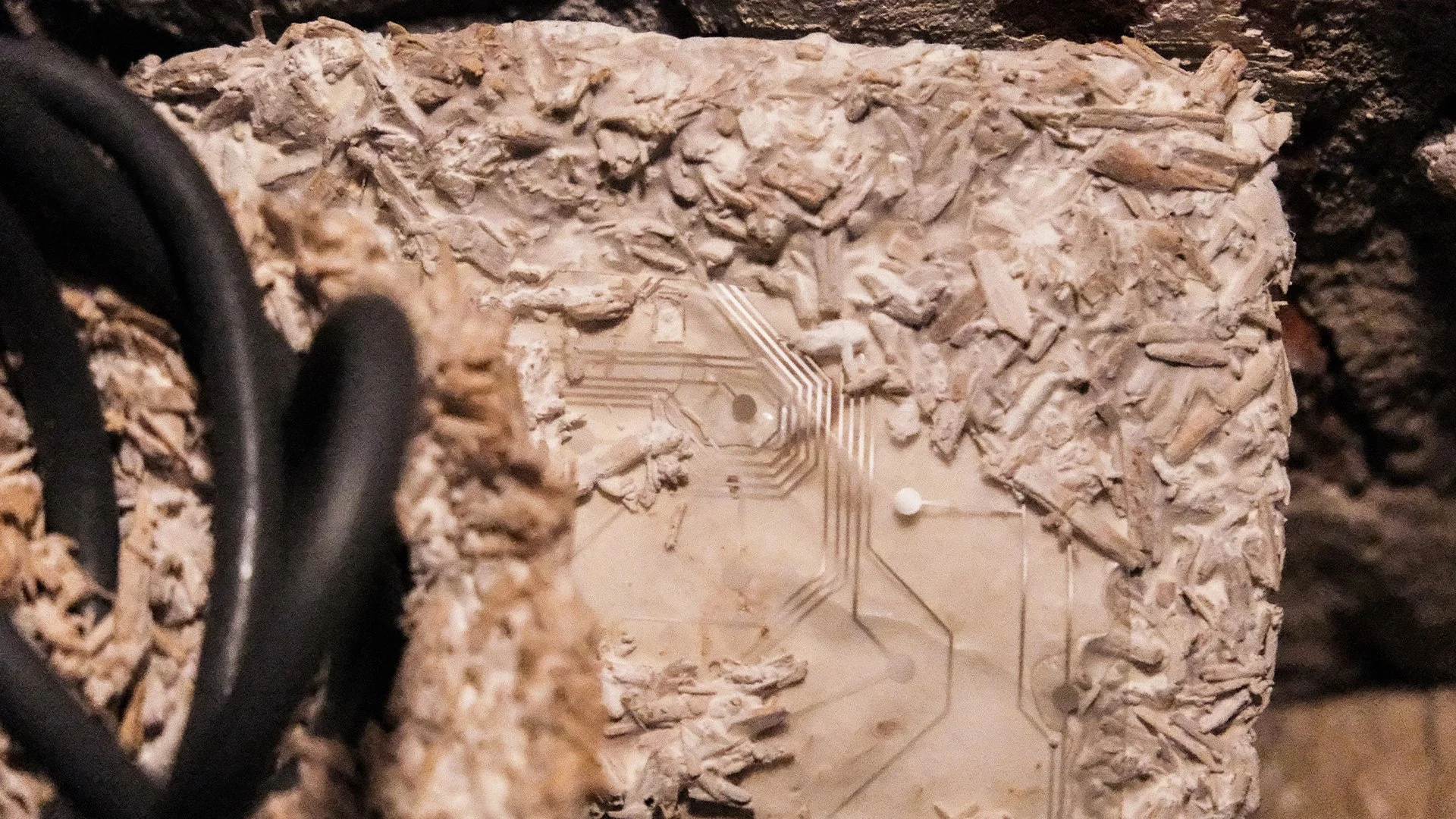
2.
The plastics have survived, choking the soil as it forms layers of synthetic rubbish—sites of digital waste become living museums of obsolescence.
The familiar is extinct, but the unwanted is abundant.
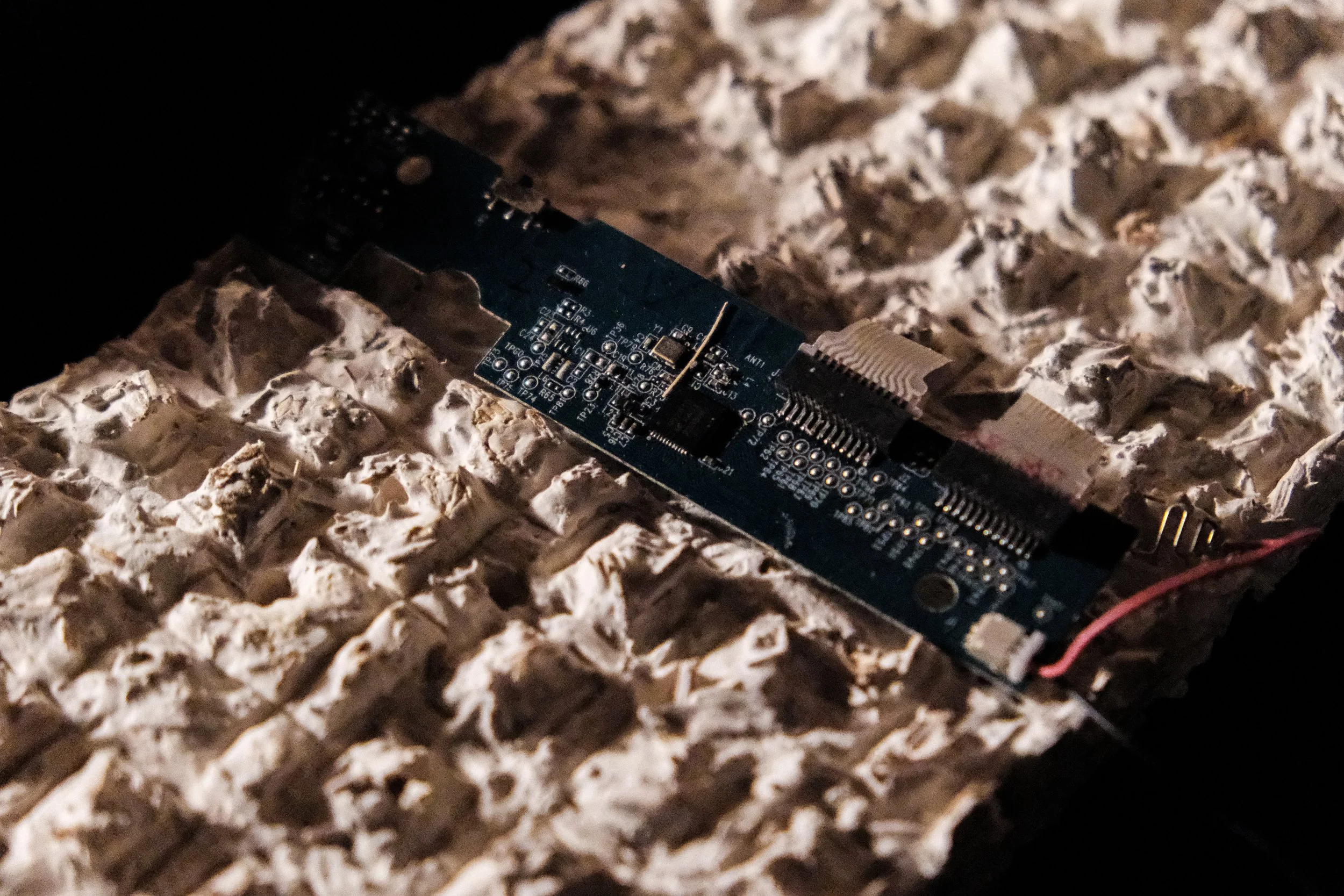
3.
Navigating the labyrinths of waste, the foraging mycelial threads emerged as agents of renewal.
Our waste, their feast.
A collaboration between fungi and obsolete technologies, landfills transform into experimental labs overflowing with potential
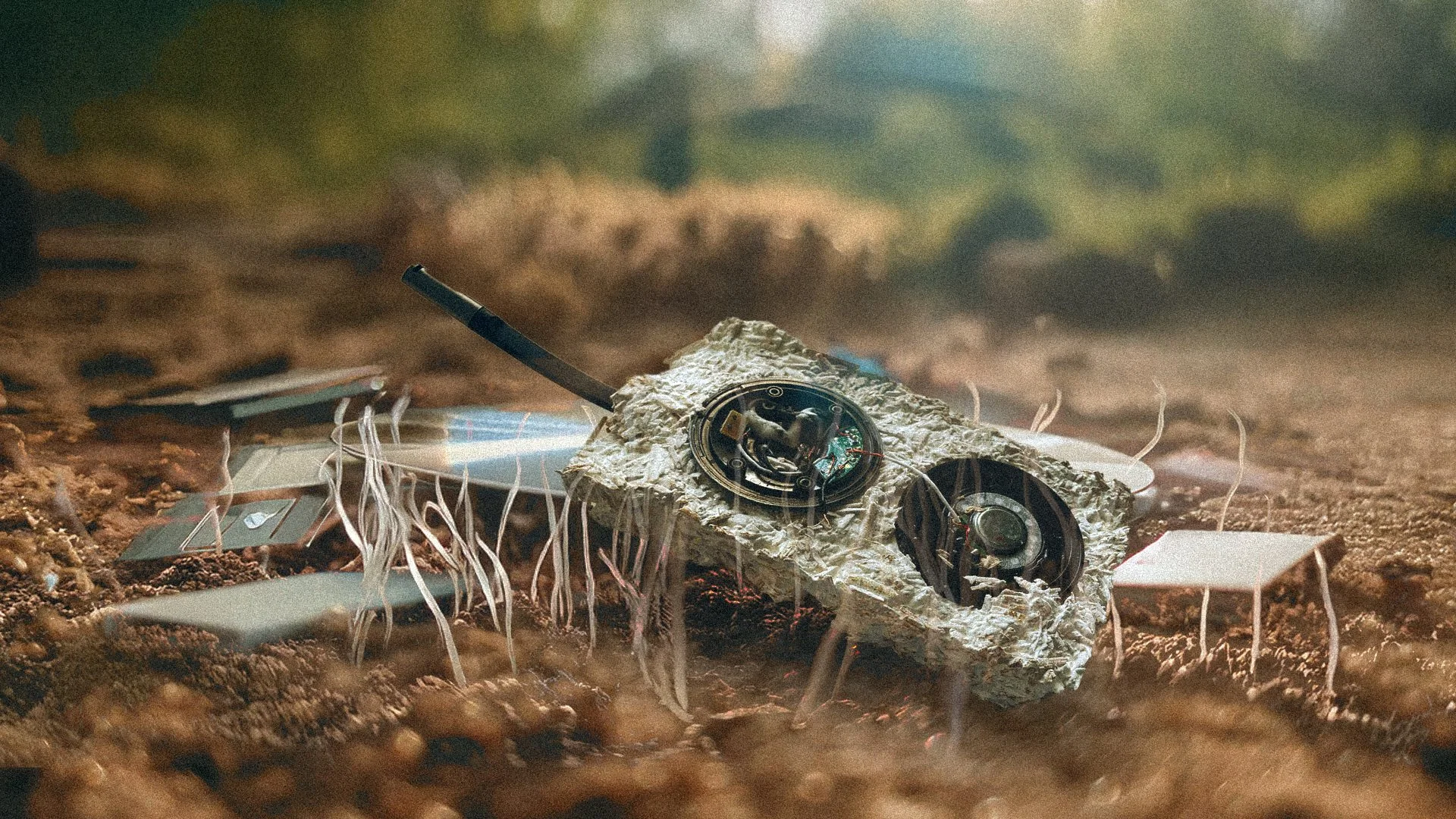
4.
It is now the world of mycelium networks repurposing digital fossils. Designers of this new world, they create and
co-exist with the natural and synthetic, birthing new, unfamiliar forms, redefining everyday devices — glitching, growing, sensing.
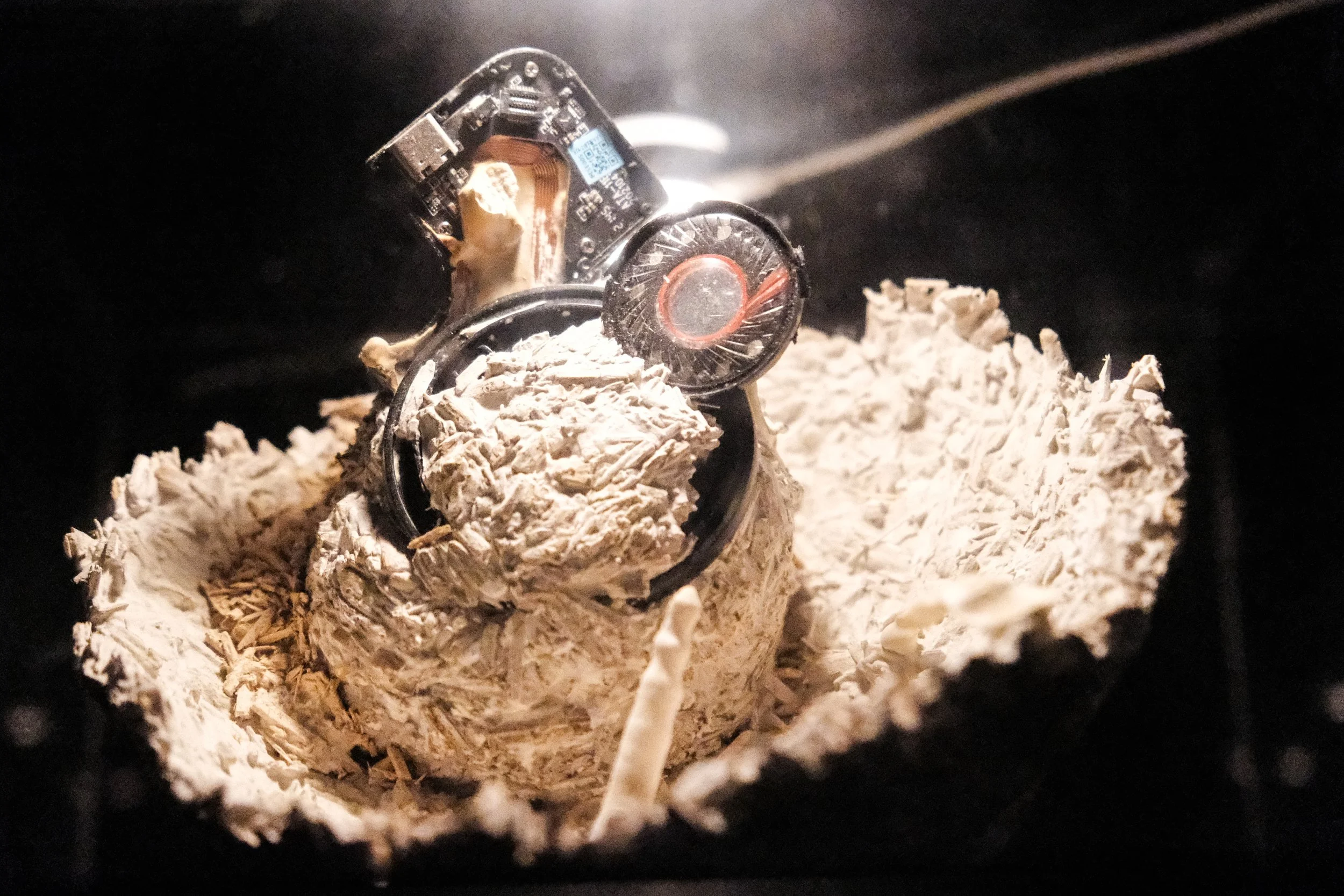
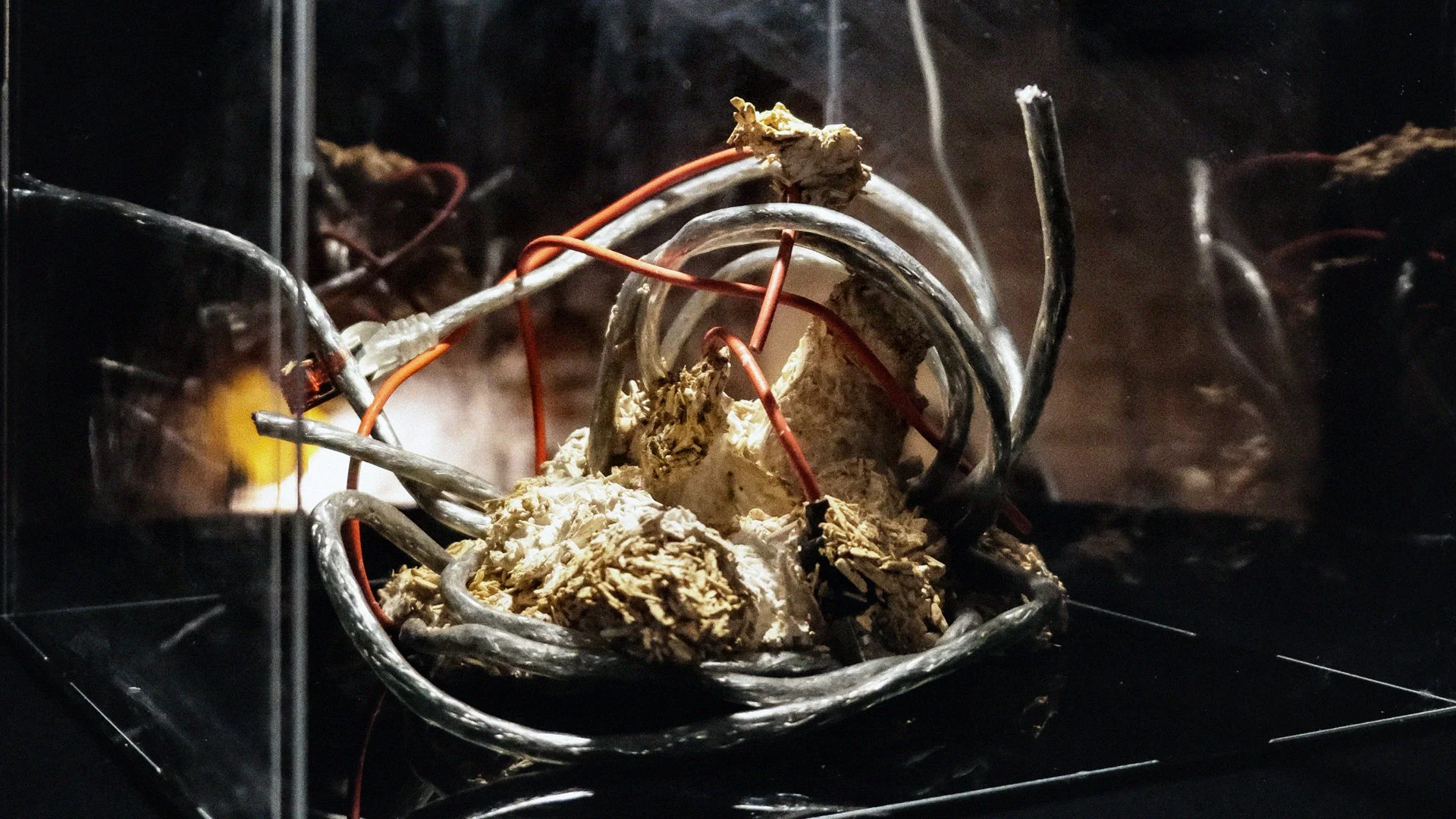
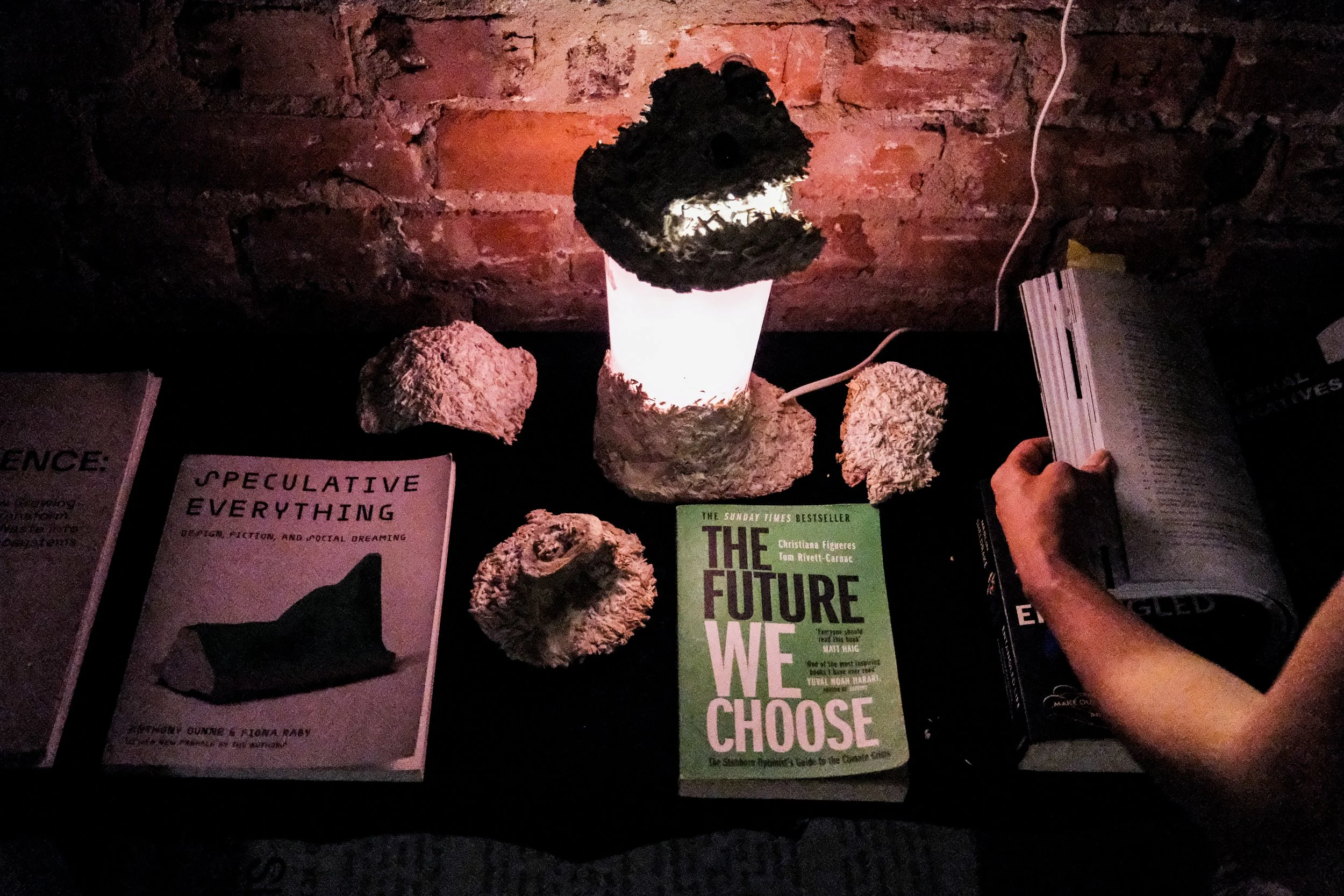
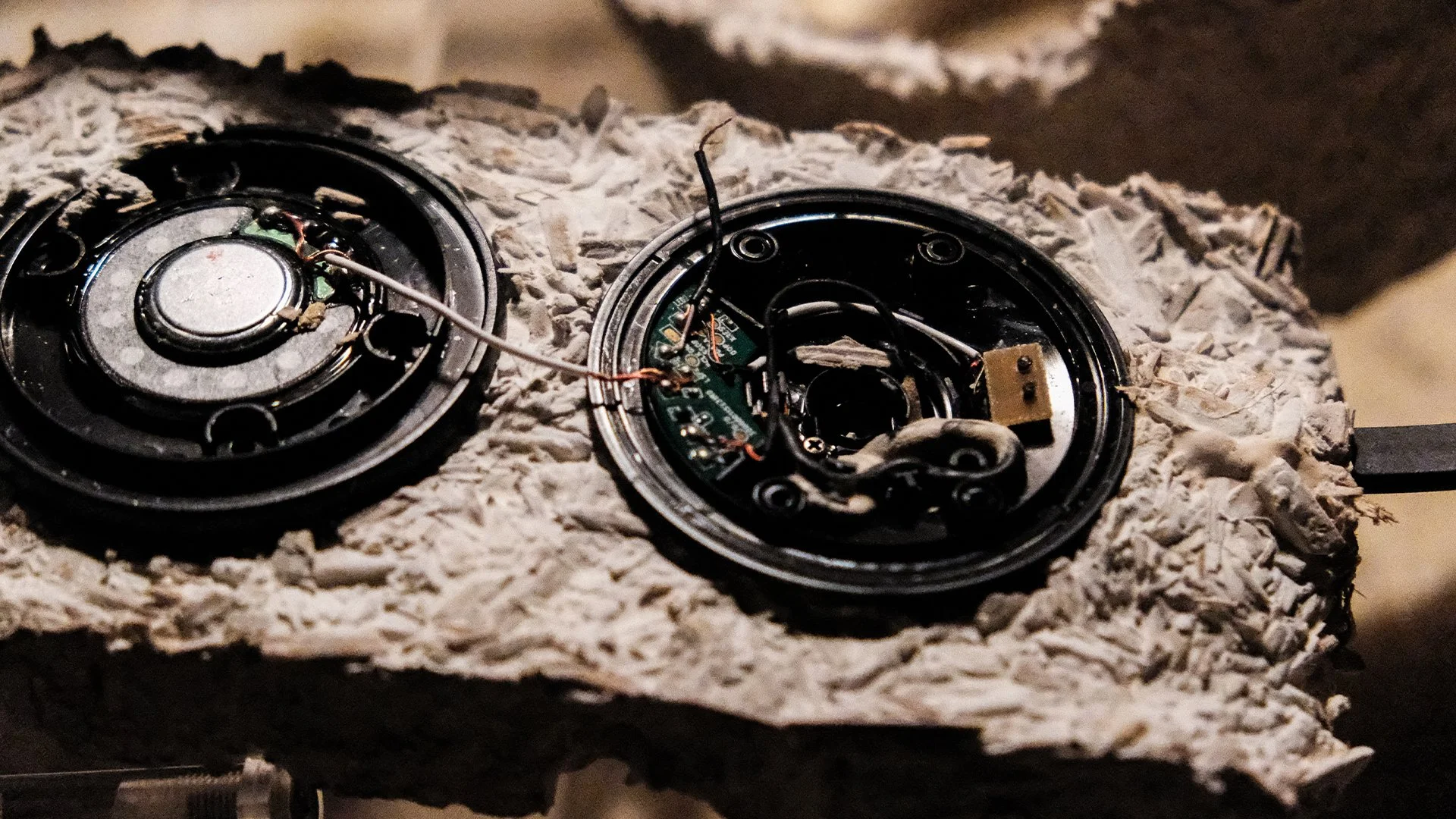
HUMANS AT THE MUSEUM
OF OBSOLESCENCE
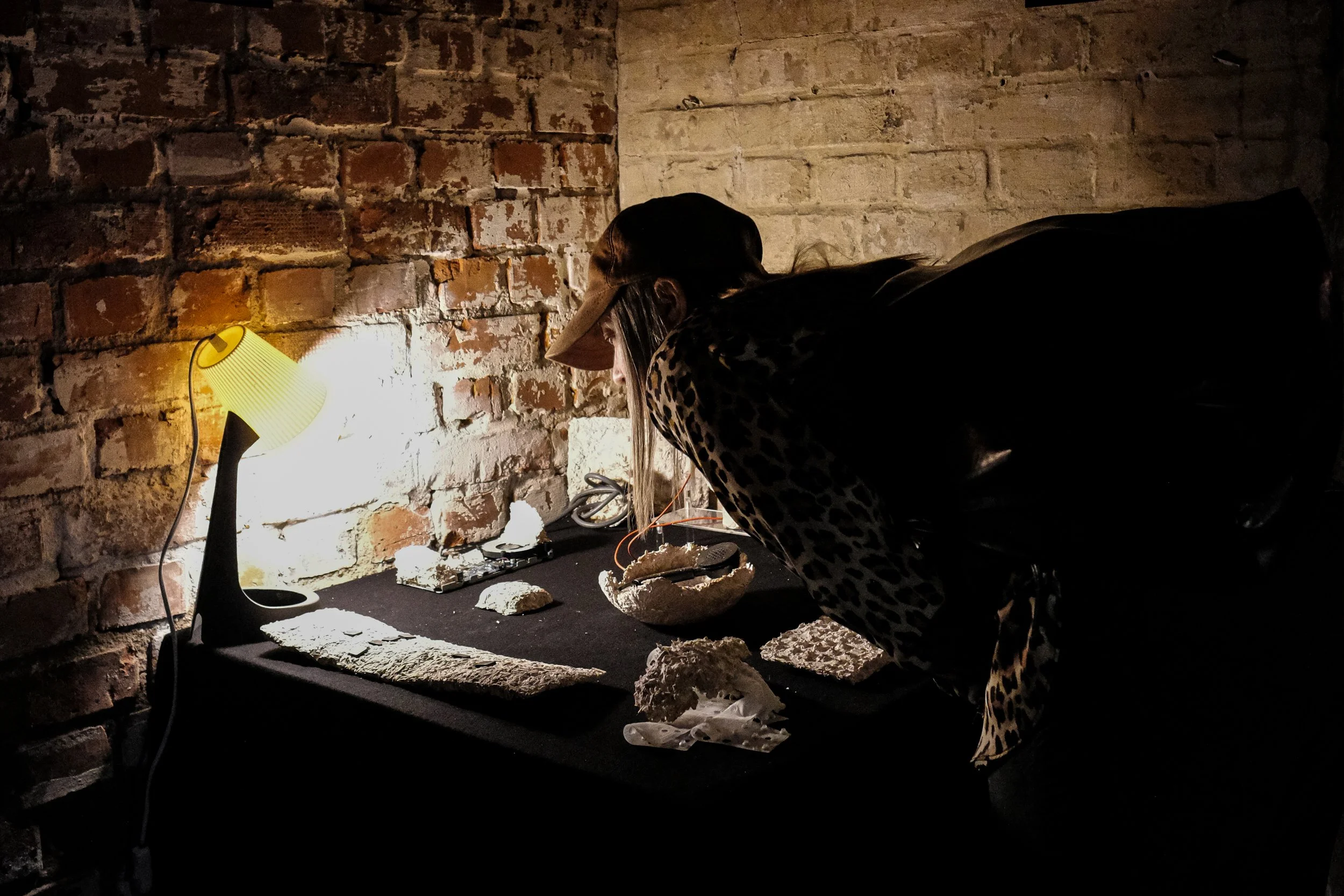
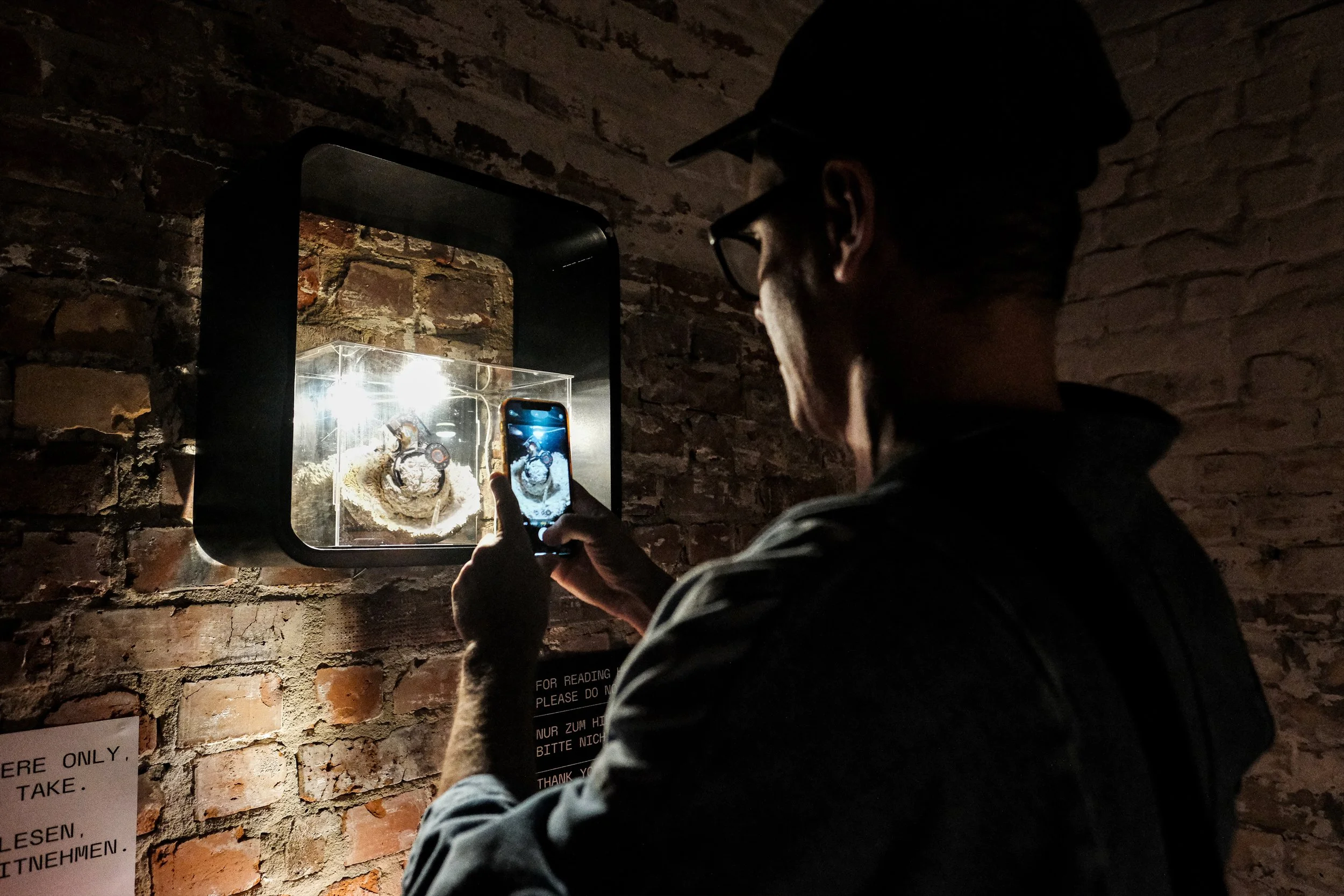
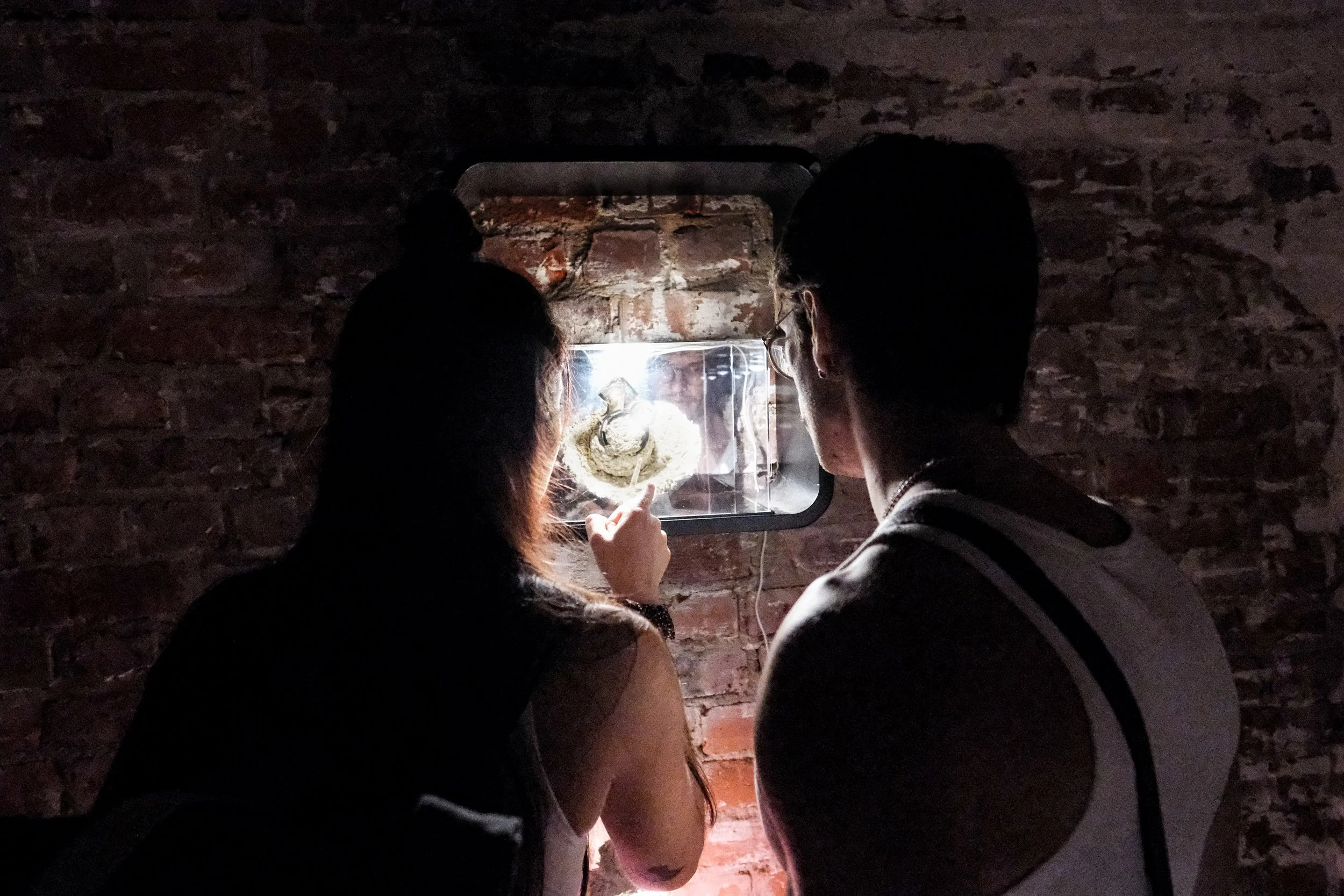
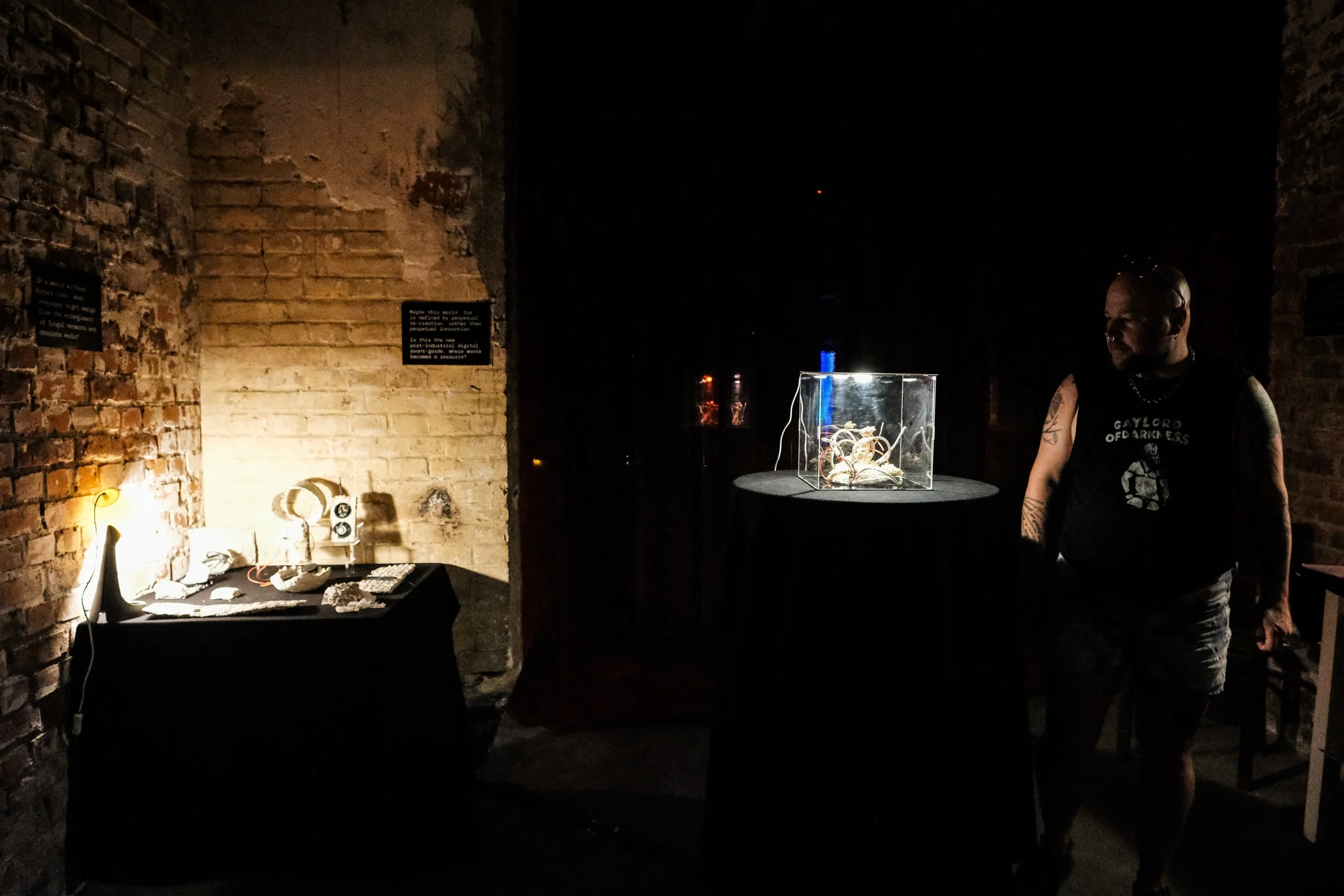
| Photos by Ayça Tuğran |
Entangled systems exhibited as a part of the exhibition ‘Intelligent Kin’ at MaHalla Berlin during Berlin New Media Week & Berlin Art Week
<Sept 2025>
reimagining a past that once witnessed the waste thumping, falling, vibrating, breaking, and glitching through ambient sound textures.
This soundscape is framed as a recovered recording, found years later from a device once thought obsolete.
Sounds of
soil memory

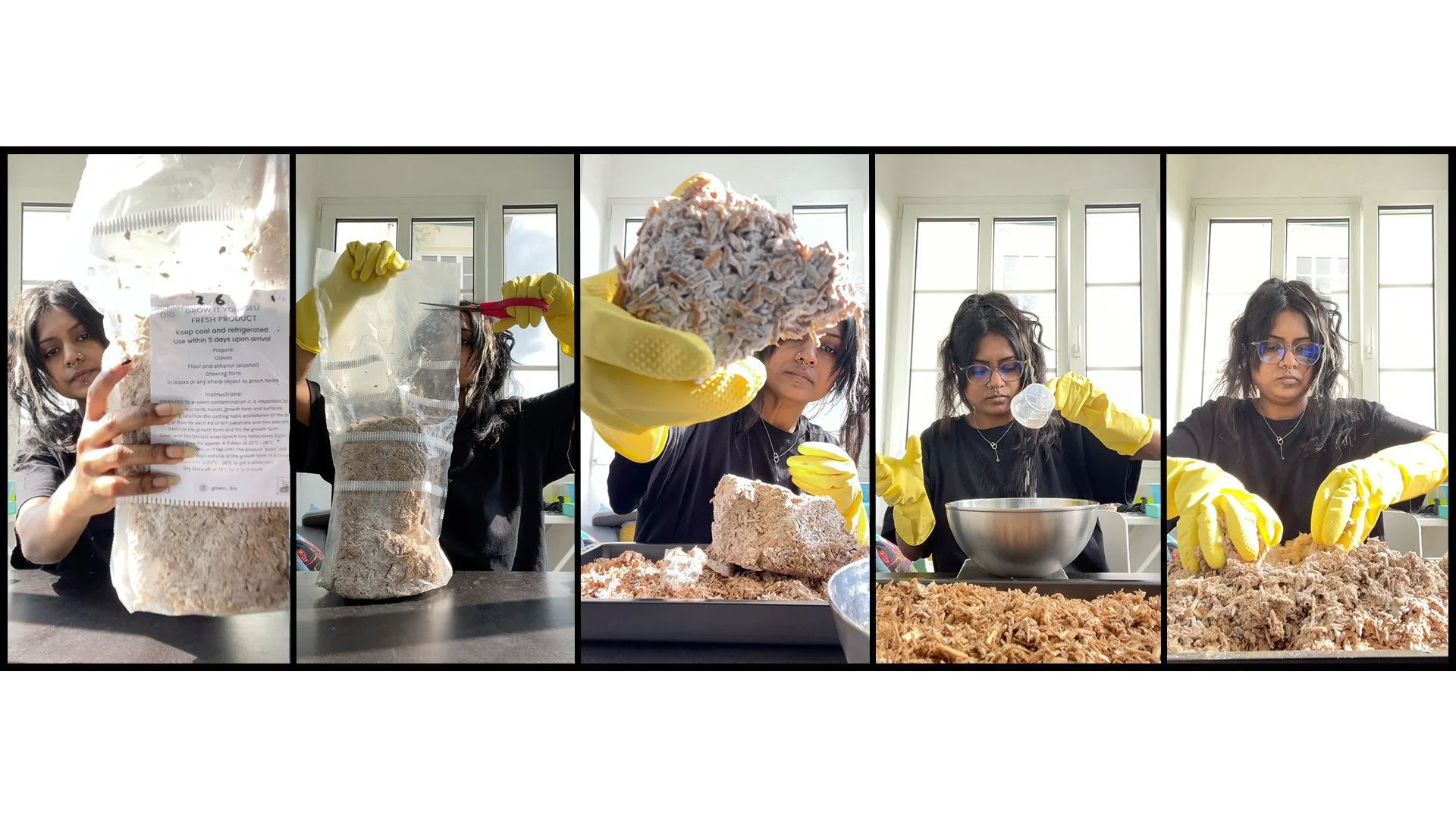
'GROWING' PROTOTYPES
>>>
'GROWING' PROTOTYPES >>>

-
Cubitt, S. (n.d.). Framed: Sean Cubitt. Retrieved June 19, 2025.
Dhanani, R. (2025). The history of planned obsolescence | Timeline infographic. The Sustainable Agency. https://thesustainableagency.com/blog/the-history-of-planned-obsolescence/
Dunne, A., & Raby, F. (2013). Speculative everything: Design, fiction & social dreaming. The MIT Press. https://dunneandraby.co.uk/content/books/690/0
E-waste facts and statistics. (n.d.). Business Waste. Retrieved June 23, 2025, from https://www.businesswaste.co.uk/your-waste/weee-recycling/e-waste-facts-and-statistics/
Eva-Maria, W. (2024). ChatGPT’s power consumption: Ten times more than Google’s.Heise Online.https://www.heise.de/en/news/ChatGPT-s-power-consumption-ten-times-more-than-Google-s-9852327.html
ewastemonitor. (2024, March 20). The global e-waste monitor 2024.E-Waste Monitor.https://ewastemonitor.info/the-global-e-waste-monitor-2024/
Examined life [Documentary]. (2009). Sphinx Productions. https://www.imdb.com/title/tt1279083/
Ferrell, M. (2021, June 22). Is fungus the plastic of the future? - Undecided with Matt Ferrell.https://undecidedmf.com/episodes/is-fungus-the-plastic-of-the-future/
Gabrys, J. (2013). Digital rubbish: A natural history of electronics. The University of Michigan Press. https://library.oapen.org/handle/20.500.12657/24019
Gabrys, J., Starosielski, N., & Walker, J. (2016). Re-thingifying the internet of things.https://research.gold.ac.uk/id/eprint/18074/1/Gabrys_Rethingifying_SustainableMedia.pdf
Hertz, G., & Parikka, J. (2012). Zombie media: Circuit bending media archaeology into an art method. Leonardo, 45(5), 424–430. https://doi.org/10.1162/LEON_a_00438
Joe, T. (2021, February 22). ’Shroom FitBit: Processors in tech wearables could be replaced with fungi mycelium, new study finds.Green Queen.https://www.greenqueen.com.hk/processors-in-tech-wearables-like-fitbits-could-be-replaced-fungi-mycelium-new-study-finds/
Kloiber, J., & Jain, A. (2023). From active hope to tangible realities: An interview with futures leader Anab Jain.Ding Magazine.https://dingdingding.org/issue-5/from-active-hope-to-tangible-realities-an-interview-with-futures-leader-anab-jain/
Karana, E., Barati, B., Rognoli, V., & Zeeuw van der Laan, A. (2015). Material driven design (MDD): A method to design for material experiences. International Journal of Design, 9(3), 35–54.
Karana, E., Blauwhoff, D., Hultink, E.-J., & Camere, S. (2018). When the material grows: A case study on designing (with) mycelium-based materials. International Journal of Design, 12(2).
London, B. (2014). Ending the depression through planned obsolescence. Revue du MAUSS, 44(2), 47–50.
Material Atlas. (2019). The growing pavilion.https://thegrowingpavilion.com/material-atlas/
Material Matter. (2018). Jovis Verlag GmbH.
McLuhan, E. (2018, April 29). Eric McLuhan: “Media ecology in the 21st century” [Video]. YouTube.https://www.youtube.com/watch?v=dbs3Fp0Uu5k&t=2775s
McLuhan, M., Fiore, Q., & Agel, J. (1967). The medium is the massage. Gingko Press Inc.
Merlin Sheldrake. (2021). Entangled life: How fungi make our worlds, change our minds, and shape our futures.https://www.merlinsheldrake.com/entangled-life
Merlin Sheldrake - how fungi make our worlds - YouTube. (2025, June 11). YouTube.https://www.youtube.com/
Montalti, M. (2010). Officina Corpuscoli » Continuous bodies – The ephemeral icon.https://www.corpuscoli.com/projects/the-ephemeral-icon/
Nitsche, M. (2022). Vital media: Making, design, and expression for humans and other materials. The MIT Press.
Ore Streams—FormaFantasma. (2017). http://formafantasma.com//work
Parikka, J. (2011). Medianatures: The materiality of information technology and electronic waste.https://livingbooksaboutlife.org/pdfs/bookarchive/Medianatures.pdf
Parikka, J. (2018). Medianatures. Zeitschrift Für Medien- Und Kulturforschung, 9(1), 103–116.
Parikka, J., & Hertz, G. (2021). A geology of media.CCCB LAB.https://lab.cccb.org/en/a-geology-of-media/
peiqi. (2025, June 3). Mushroom iPad keyboard.Instructables.https://www.instructables.com/Fungus-IPad-Keyboard/
Postman, N. (2000). The humanism of media ecology. Proceedings of the Media Ecology Association, 1, 10–16.
Razghandi, K. (2024). Rethinking growth: A bio-inspired take on creative processes. In Toward a new culture of the material (pp. 139–150). De Gruyter. https://doi.org/10.1515/9783110714883
Refuge for Resurgence. (2021). Superflux.https://superflux.in/index.php/work/refuge-for-resurgence/
Scaling-Up-Formafantasma. (2018). Walker.https://walkerart.org/magazine/scaling-up-formafantasma/
Schoenberg, K. (2022). What if our phones had skin? Issues in Science and Technology.https://issues.org/bacteria-phone-case-skin-self-charging-biodesign/
Starosielski, N., & Walker, J. (2016). Sustainable media. Routledge.
Studio Possible Futures (Director). (2019). The growing pavilion documentary [Video]. https://www.youtube.com/watch?v=rbsj9fzykNs
Superflux. (2017–2019). Mitigation of shock (London).https://superflux.in/index.php/work/mitigation-of-shock/
Superflux. (2021). The intersection.https://superflux.in/index.php/work/the-intersection/
Superflux. (2025). Serious play [Substack newsletter]. Superflux.https://superflux00.substack.com/p/serious-play
Thwaites, T. (2010). How I built a toaster—From scratch [Video]. TED.https://www.ted.com/talks/thomas_thwaites_how_i_built_a_toaster_from_scratch
Thwaites, T. (2011). The toaster project. Princeton Architectural Press.
Weintraub, L. (2019). What’s next? Eco materialism & contemporary art. Intellect Books. https://intellectdiscover.com/content/books/9781783209408
World Health Organization. (2024). Electronic waste (e-waste).https://www.who.int/news-room/fact-sheets/detail/electronic-waste-(e-waste)
Widmer, R., Oswald-Krapf, H., Sinha-Khetriwal, D., Schnellmann, M., & Böni, H. (2005). Global perspectives on e-waste. Environmental Impact Assessment Review, 25(5), 436–458. https://doi.org/10.1016/j.eiar.2005.04.001